
Last updated: September 2026
The law of attraction is the belief that your thoughts and feelings shape what you experience. The five most popular techniques are feeling-based affirmations, visualization, scripting, clearing limiting beliefs, and taking inspired action. They work best as tools for clarity, motivation, and mindset, combined with real-world effort.
If you’ve tried “thinking positive” and felt like nothing changed, you’re not alone. Most advice stops at the slogan. This guide shows what to actually do, step by step, and keeps expectations realistic.
What is the Law of Attraction?
The law of attraction is the idea that your dominant thoughts, beliefs, and emotions draw matching experiences into your life. Supporters describe it as alignment: getting your thoughts, feelings, and actions pointing in the same direction.

An honest note: there’s no scientific evidence that thoughts alone attract outcomes. What research does support is that clear goals, focused attention, and realistic planning improve follow-through. Many people find manifesting useful because it encourages exactly those things. Treat it as a mindset practice, not a guarantee.
5 Law of Attraction Techniques
1. Feel It, Don’t Just Say It (Affirmations With Emotion)
Repeating “I am abundant” while feeling hopeless creates a gap between words and belief. Pair the phrase with a genuine feeling.
How to do it:
- Pick one believable statement, such as “I’m building a stable, abundant life.”
- Say it slowly for a minute or two.
- Recall a real moment when you felt secure or proud, and let that feeling accompany the words.
If an affirmation feels false, soften it: “I’m open to new opportunities” is easier to believe than “I’m a millionaire.”
2. Visualization
Visualization means mentally rehearsing what you want in detail. The richer the detail, the more motivating it tends to feel.

How to do it:
- Sit quietly for 3 to 5 minutes.
- Picture a specific moment: where you are, what you see, hear, and feel, and who’s with you.
- Then picture one obstacle and how you’d handle it.
That last step matters. Research by psychologist Gabriele Oettingen suggests that imagining only the perfect outcome can actually lower effort, while pairing the dream with realistic obstacles and a plan improves follow-through.
3. Scripting
Scripting is writing about your desired life as if it’s already happening. Writing slows your thinking down and makes vague wishes specific.
Example: “I’m so grateful to be working in a role I love. I start my mornings calm and focused, and I’m proud of the projects I’m leading.”
How to do it: write for 10 minutes, in present or past tense, with emotion and detail. End with one concrete action you’ll take this week.
4. Clear Limiting Beliefs
Beliefs like “money is hard to come by” or “good things don’t happen to me” can quietly shape your choices, such as not applying, not asking, or not trying. Clearing them is often the most valuable part of manifesting.
How to do it:
- Write the belief down.
- Ask: Where did I learn this? What evidence contradicts it?
- Rewrite it into something more balanced (“Money takes effort, and I’m learning how to grow mine”).
Journaling can help. If beliefs feel deeply rooted or tied to painful experiences, a therapist can support this work better than any technique.
5. Take Inspired Action
Manifesting works best when paired with movement. You can set the GPS, but you still have to drive.
How to do it:
- Turn your vision into one small step this week (send the application, book the call, save $50).
- Write an if-then plan: “If it’s 8 a.m. Monday, then I’ll spend 20 minutes on my portfolio.”
- Notice opportunities you’d normally skip, and act on them.
Part of why people feel “coincidences stack up” is that focusing on a goal trains your attention to notice relevant chances. That’s a real effect of attention, and you benefit from it by acting.
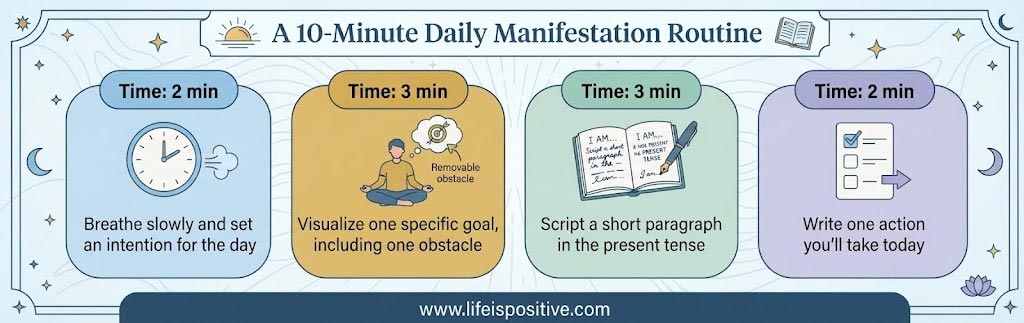
Do it for 21 days, then review what shifted in your habits, confidence, and results.
Common Mistakes to Avoid
- Waiting instead of acting. Visualization isn’t a substitute for effort.
- Only positive fantasies. Plan for obstacles too.
- Blaming yourself. If something doesn’t work out, it doesn’t mean your thoughts were “wrong.” Life involves factors beyond your control.
- Making big financial decisions based on manifesting. Stay grounded, especially with money.
- Ignoring mental health. If you feel persistently low or anxious, reach out to a professional. Manifesting is not a treatment.
FAQ
Does the law of attraction really work?
There’s no evidence that thoughts alone change outside events. Techniques like goal visualization, journaling, and planning can boost motivation and focus, which can improve results.
How long does manifesting take?
There’s no set timeline. Goals that depend on your actions, like a new skill or job search, move as fast as your effort. Others involve factors outside your control.
What is the 3-6-9 method?
It’s a popular practice of writing an intention 3 times in the morning, 6 times in the afternoon, and 9 times at night. It works as a repetition and focus routine, not as a proven technique.
What is scripting in manifestation?
Writing about your desired future as though it’s already real, with detail and emotion.
Why isn’t my manifestation working?
Common reasons include vague goals, unaddressed limiting beliefs, no action plan, and unrealistic timelines. Try making the goal specific and adding one weekly action.
For more empowering content, connect with our vibrant community here ➡️ Social Media.
This article is for inspirational and educational purposes and isn’t a substitute for professional mental health, medical, or financial advice.


