
Medically reviewed by Jean Espinoza, Physician | Updated September 2026
Let’s be real — everyone talks about self-care, but very few people talk about what actually works. A self-care routine for mental health isn’t about bubble baths and scented candles (though hey, no judgment there). A real self-care routine for mental health is about building daily habits that genuinely protect your mind, restore your energy, and help you show up as your best self — even on the hard days.
And that’s exactly what we’re diving into today.
Everyone talks about self-care, but few talk about what actually helps. It isn’t just bubble baths and candles (though there’s nothing wrong with those). Real self-care is about daily habits that protect your mind, restore your energy, and help you cope on the hard days.
Why a Routine Helps
When days feel chaotic and unpredictable, your body can stay in a low-level state of alert. Structure, even a loose one, gives your brain predictable anchors: when you wake, when you move, when you wind down. A routine won’t fix everything, but it creates a steadier foundation to handle stress.
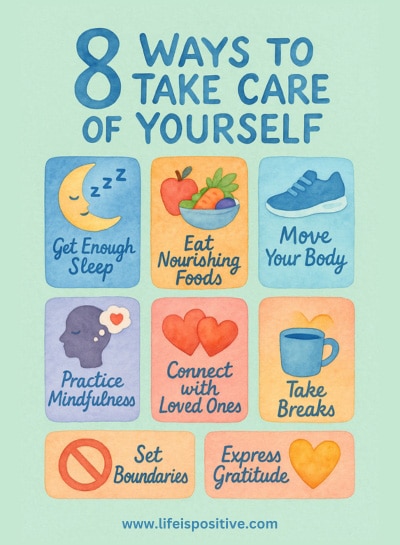
7 Daily Habits for a Mental Health Self-Care Routine
1. Start the Morning Without Your Phone
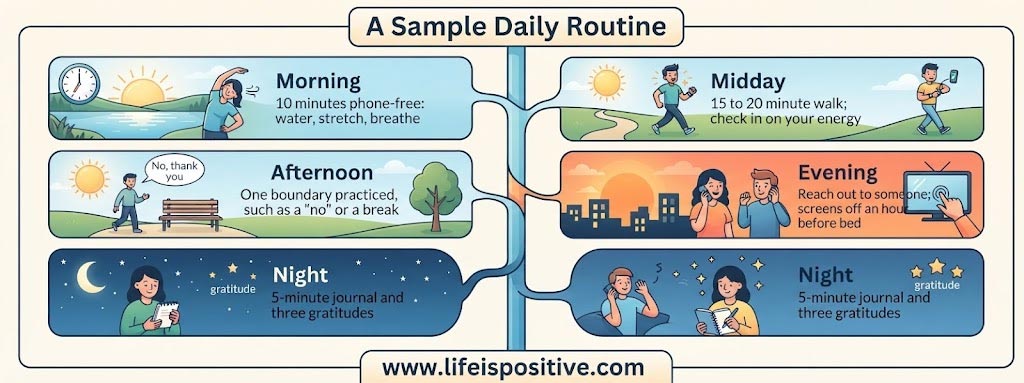
Many of us reach for our phones within minutes of waking and immediately take in news, messages, and notifications. Try giving yourself the first 10 to 15 minutes to stretch, drink water, breathe, or simply sit. Many people find it sets a calmer tone for the day.
Try this: charge your phone across the room so it isn’t the first thing you reach for.
2. Move Your Body, Even a Little
Regular physical activity is one of the best-supported habits for mood and stress. It doesn’t need to be intense. A 20-minute walk, a stretching session, or dancing in your kitchen all count.
Try this: attach movement to something you already do, like walking for 10 minutes after lunch.
3. Protect Your Sleep
Sleep loss affects emotional regulation, focus, and resilience. Aim for 7 to 9 hours, keep a consistent bedtime, dim lights an hour before bed, and put screens away. A wind-down routine signals your body that the day is ending.
4. Journal for Five Minutes
Writing helps you process emotions before they pile up. You don’t need pages or perfect sentences. Try two prompts:
- What am I feeling right now?
- What do I need today?
Read: How Important Is Self-Care
5. Set Boundaries and Keep Them
Overcommitting and saying yes when you mean no drain mental energy. Boundaries are a form of self-care.
Try this: practice a simple script, such as “I can’t take that on right now, but thanks for thinking of me.” Start with low-stakes situations.
6. Connect With Someone Who Gets You
Social connection is a core mental health need, not a luxury. Aim for at least one meaningful conversation a week. Text an old friend, call a sibling, or have coffee with a colleague. Quality matters more than quantity.
7. End the Day With Gratitude
Before bed, name three things that went well, however small. Research suggests regular gratitude practice can modestly improve wellbeing over time. It works best as a realistic acknowledgment of good moments, not as forced positivity about real problems.
A Low-Energy Version for Hard Days
When you’re exhausted or struggling, aim for the minimum:
- A glass of water and a few slow breaths
- Five minutes outside or by a window
- One text to someone you trust
- Bed at a reasonable time
Doing the minimum still counts. Missing a day doesn’t erase your progress.
How to Build Your Routine in 4 Steps
- Pick one habit that feels easiest, not the most impressive.
- Anchor it to an existing routine (after brushing your teeth, before your first coffee).
- Do it for a week, then reflect on how you feel.
- Add a second habit. Build slowly, and drop what doesn’t fit.
Self-Care vs. Self-Indulgence
Sometimes self-care means resting or treating yourself. Sometimes it means doing something difficult, like a budget review, a doctor’s appointment, or a hard conversation. A useful question is: Will this help me feel better over the long run, not just right now?
When Self-Care Isn’t Enough
Self-care supports mental health, but it isn’t a replacement for professional care. Consider reaching out to a doctor, counselor, or therapist if:
- Low mood, anxiety, or hopelessness lasts more than a couple of weeks
- You’re struggling to function at work, school, or home
- Your sleep or appetite has changed significantly
- You’re using alcohol or other substances to cope
- Self-care habits feel impossible to keep up
Asking for help is a healthy step, not a failure.
If you’re in crisis or having thoughts of harming yourself, call or text 988 in the US or Canada, or contact your local emergency number or crisis line right away.

FAQ
What should a self-care routine for mental health include?
Sleep, movement, social connection, time to process emotions (like journaling), boundaries, and something restful or enjoyable. Personalize it to your life.
How long does it take for self-care to improve mental health?
Some habits, like a walk or breathing exercise, can help you feel better right away. Benefits from habits like better sleep and regular exercise build over weeks.
What are simple self-care ideas when I have no time?
Take three slow breaths, step outside for five minutes, send one kind message, or go to bed 15 minutes earlier.
Is self-care selfish?
No. Caring for your basic needs helps you show up better for the people and work you care about.
Can self-care replace therapy?
No. Self-care can support wellbeing, but therapy and medical care treat conditions like depression and anxiety disorders.
This article is for informational purposes only and isn’t a substitute for professional medical or mental health advice, diagnosis, or treatment.
Sources: National Institute of Mental Health (NIMH), American Psychological Association, Mayo Clinic, Canadian Mental Health Association
For more empowering content, connect with our vibrant community here ➡️ Social Media.


